
Uncover high-probability A/B test ideas. Run them as high-powered experiments.

- Experiment design & analysis
- UI design
- Experiment strategy
- UI prototyping & front-end dev
1,600+ experiments designed· 600+ published· 15 years experience· worked with Microsoft, Booking, LinkedIn
Choose a conversation starter:
to uncover 5-10% tests worth retesting.
Why? As we run experiments, we forget that some of our inconclusive, winning and/or losing results have a lot more potential as reruns.
 weak but promising results,
  strong ones worth doing more of, and
  negative results worth inverting.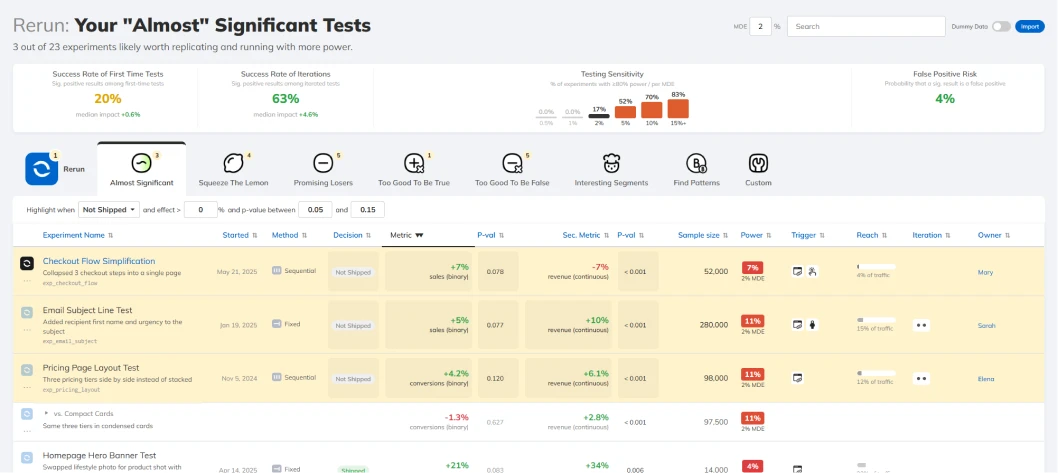
Powered by Rerun, our open-source tool for highlighting what is worth replicating. Having at least 50+ past experiments is a great starting point.
to uncover 15-30 high-probability test ideas.
Why? As we come up with test ideas, we rarely tap into priors from experiments other companies have already run, which raise our win rates and impact.
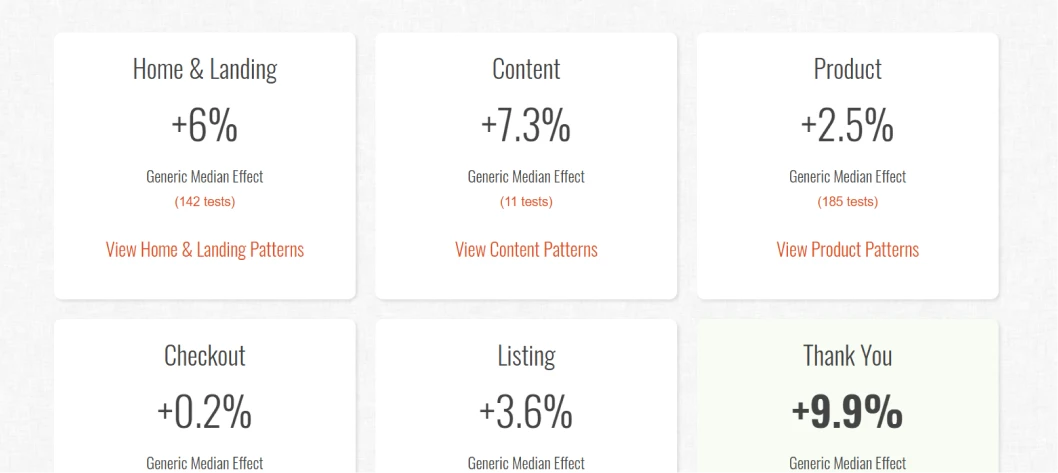
Powered by GoodUI, our library of 600+ A/B tests from other companies. Best suited for teams already running experiments.
run more tests to multiply your program.
Concurrency · Rapid Prototype Testing · Iteration · Democratization · Sharing Results Across Company · Automate Reruns
increase trust and reduce noise of your results.
Power Checks · Stopping & Ship Rules · SRM & Guardrail Checks · Business-Aligned Metrics · Crowd-Based Prioritization · Reporting
Have Something Else On Your Mind? Discuss A Custom Project
Ongoing retainer · Monthly advisory · Custom projects · Experiment reviews & training
Historical Results
Relative median effects from past experiments you can expect on projectsfor metrics such as: LEADS SALES SIGNUPS REVENUE
on smaller experiments
Source: GoodUI data; N = ~600
on larger “leap” experiments
Source: Linowski "Leap" projects; N = 50
SCREEN TYPES WE HAVE THE MOST EXPERIENCE DESIGNING & OPTIMIZING FOR
 Landing &
Home Pages
 Product
Pages
 Listing
Pages
 Signup
Funnels
 Checkout
Funnels
 Pricing
Pages
HI, I’M JAKUB
OVER
15yrs
experience designing front-end UI A/B tests
COACHED
~100
experimentation & growth teams
PUBLISHED
~600
experiments on GoodUI
WITH
2
design degrees
AND A

for stats & numbers
WHERE DO HIGH-PROBABILITY
IDEAS COME
FROM?
Companies I Worked With
Over 15 years, I've designed ~1,600 A/B tests for teams like these.

Companies I Coached / Learned From
I've coached ~100 growth teams, learning together what works and what doesn't.

INGREDIENTS FOR SUCCESS
PUBLICATIONS
- Kohavi, R., Linowski, J., Vermeer, L., Andreev, A., Dodin, M., & Furuseth, J. (2026). Trustworthy A/B Patterns and the Winner's Curse: Lessons from Eight Large-Scale Replications. Proceedings of the 32nd ACM SIGKDD Conference on Knowledge Discovery and Data Mining, 7533–7544.
- Kohavi, R., Linowski, J., Vermeer, L., Boisseranc, F., Furuseth, J., Gelman, A., Imbens, G., & Rajagopal, R. (2026). Power Analysis Is Essential. Econ Journal Watch, 23(1).
- Linowski, J. (2026). Experiment Estimation Study. GoodUI.
- Linowski, J. (2022). Beyond Opinions About Opinions: Real A/B Test Prediction Rates From 70,000 Guesses. GoodUI.
- Linowski, J. (2024). Do Some Sources Of Experiment Ideas Lead To Higher Win Rates Than Others?. GoodUI.